|

|
About the Lowchen
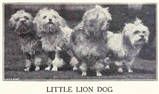
Photo by Van Damme taken in 1913
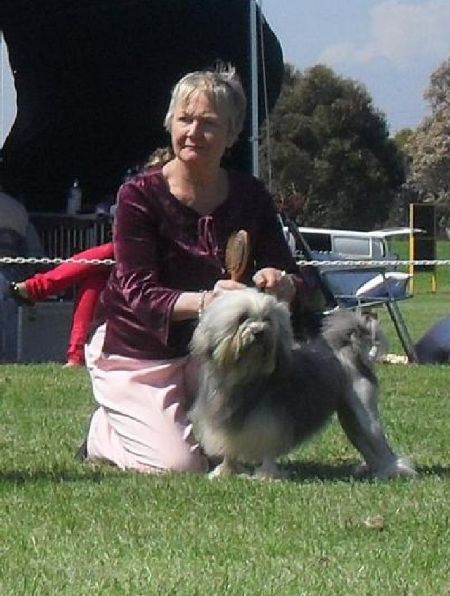
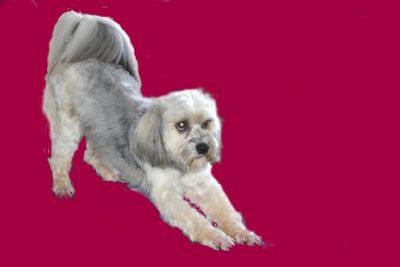
About the Löwchen From Wikipedia, the free encyclopedia The Löwchen (German: "little lion") is a breed of dog that once had the dubious distinction, like the Portuguese Water Dog and the Havanese, of being the rarest dog in the world. Even today, the breed generally has fewer than a few hundred new registrations each year worldwide. DescriptionAppearanceThe Löwchen is bichon related breed, with a long, silky coat that is presented in a lion cut. This means that the haunches, back legs, front legs (except bracelets around the ankles), and the 1/3 of the tail closest to the body are shaved, and the rest of the coat is left natural to give the appearance of a lion-like form. A small dog, they are considered by some registries as toy dog, and have been long-time companions of royal courts. The head of the Löwchen is one of the most important features, with its relatively short, wide muzzle, broad skull, lively round eyes, and pendulant ears. The head, when in proportion to the body, is neither too big nor too small, but helps to emphasize the friendly, regal, and leonine personality of the Löwchen. The coat should not be thin and fluffy like a Bichon Frise, but wavy with a mix of thicker hairs amongst the fine ones. This allows for a flowing coat that is not frizzy or fly-away, and a Löwchen coat should neither be soft like a nor harsh like many terriers. They can come in all colours, including brown, that allow for dark eyes and nose. TemperamentThe Löwchen is a friendly, happy dog. Dogs of this breed are both active and playful, and very intelligent. The Löwchen makes a good pet for families with children and an excellent house pet. HistoryAlthough this dog may be related to the Bichon Frise, the Löwchen's history remains obscure. The little 'lion dog' is seen in many art pieces featuring dogs as far back as the 16th century, but it is unclear whether these were all dogs like the Löwchen, or simply small dogs of the Bichon type that were trimmed in a lion cut. Source Description above from the Wikipedia article Löwchen, licensed under CC-BY-SA Average height and weight Compatibility with Other Pets Compatibility with Children Care Requirements Feeding Travelling with your Löwchen It should be noted that there is a rare, recessive gene in the breed which can produce the Smooth Coated lowchen (Smootchen). This manifests itself in shorter hair on the head and legs and a full coat on the body, although not as full as the longcoat. A smoothcoat is not a crossbreed, merely the result of breeding two normal lowchen which both carry the gene. The smootchen is just as playful and lovable and naughty as any lowchen and, for a companion dog for the home, has the added advantage of being easier to groom. The löwchen is a robust and generally sound breed with few medical problems. It is non shedding, therefore less likely to cause allergic reactions, making it a perfect all round pet for those looking for a house-mate.
|